In 2016...
I had a really big year

Mixed Realities
In 2016 I produced the content for Lady Gaga’s David Bowie Tribute at The GRAMMYs which was the first time a brand was integrated on The GRAMMY stage. It won a bunch of Cannes Lions and Clios. I was interviewed shortly thereafter for a book that Vicki Callahan, USC professor and Fulbright Scholar, and her colleague Sarah Atkinson were writing about women working in emergent media. I would later go on to co-teach a couple of classes on new media at the USC School of Cinematic Arts with Callahan.
For this post I want to focus on the interview because the book Callahan and Atkinson were working on came out in print last year. It is called Mixed Realities: Gender and Emergent Media and I am quoted a number of times in it. It is quite a feat to get published so I also want to congratulate Callahan and Atkinson and celebrate them for bringing their vision to life.
I’m proud to be represented among a group of media practitioners who were early adopters of digital and social media, VR and AR, and cross-platform storytelling practices like transmedia and ARGs. I’m also proud to be recognized by such talented and perceptive academic researcher team such as Callahan and Atkinson.
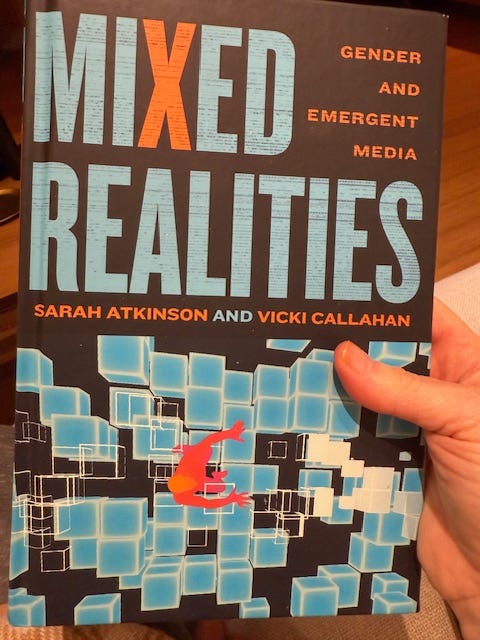
One passage from the introduction has stayed with me:
It is often the case that market conditions enable women’s permissible participation at these points of transition and emergence . . . however when the subsequent documentation and histories have been written about these innovations, women’s contributions are often absent.
What Callahan and Atkinson have done is work to reverse that trend that they identified. They put names to the work. They prevented the erasure of the contributions of women and gender fluid individuals with the publishing of this book.
No One Wants to Know What Transmedia Is
By 2016 I had been working in emergent media for 16 years. It hardly felt emergent to me. But even in 2016 it was still a hard sell. Even though most campaigns had to be cross platform and the media landscape had already completely fragmented.
At that time I talked about cross-platform storytelling instead of the official term of transmedia because it sounded less academic and more accessible. However, clients and colleagues still often responded with confusion no matter how much explanation I did. I most often would hear, “I don’t believe in Twitter.” Turns out that Twitter, and social media and emergent media in general, was not a religion. It existed despite their disbelief.
There are stories I could tell you that you just would not believe. Many, many millions of dollars spent on campaigns that when it came down to it - myself and a handful of folks on my team - were the only ones who really understood how it all worked. One time I was working to get the buy-in from our Executive Creative Director on the necessity of a hashtag. I showed him an example on Twitter of how it works as an aggregator of posts so that a storyline would form. He didn’t believe it. So I had a designer create a wireframe of Twitter and put in sample posts to show how it would work. That went further to explain it and I received sign off. Why fake Twitter was convincing and real Twitter was not I will never understand. It is likely that he figured I was probably was right if I was willing to go to the lengths I went to to explain it to him. In the end it was very clear that no one understood what a hashtag was for or how it could work to tell a story but that is a story for another day.
But, the good news is that the people who understood social and emergent media really understood the power of it. IYKYK.
There is substantial data behind why this form of storytelling works on a business level, but that’s also a conversation for another day. For now: transmedia, cross platform storytelling, when it is done correctly, is the most powerful activation a brand can have in their arsenal for brand building. Byron Sharp’s research has born out what transmedia practitioners have known all along - you needed identifiable, repeatable assets that appear where people live and when they make decisions. Bring those identifiable assets to life in an immersive way that requires investment and your brand becomes truly embedded in people’s memory.
Despite the power of transmedia and new media in general, in the mid-2000s, agencies knew they needed this kind of capability because clients were asking for it. But no one whose careers had been established in traditional media really wanted anything to do with it.
Digital media made people who had built careers around film and sixty-second spots feel like they were falling behind. At one agency, a broadcast producer said to me, “I don’t want to ever hear you say ‘code library’ ever again.” She meant it. I was shocked because as an early adopter it is in my nature to want to learn and try new things. I was excited to learn more about a Red camera, why wouldn’t someone want to understand anything they could about code and what you could do with it to make amazing experiences? I learned a hard lesson that not everyone is always as excited about the next new thing as I am.
Ten years later, with the book published, it’s worth asking: what has changed — and what hasn’t?
Ten Years Later
Today, media platforms mediate nearly every human interaction. Emerging media is no longer emerging. It is the substrate. The conversation is about AI.
The stakes feel higher and no one is saying they don’t believe in AI. They believe and they are moving…fast.
Reading Mixed Realities has reminded me if we are serious about building technology that includes and serves humans, all humans, that builds trust, belonging, and value, we are going to want to look forward strategically.
For anyone building at the intersection of creativity, technology, and culture, this book is not about the past. It is about the patterns we keep repeating, and the ones we still have time to change.
Really loved reading this and congrats on being included in the book.